Go to conference livestream
FERDIG_konferansebilde Total Defence - Ellisiv Forum 26

Total Defence – Ellisiv Forum 26

Advancing defence cooperation, societal resilience, and support for Ukraine

Expired
Date Time Location Tickets
9. Nov  - 10. Nov 2026
08:30  - 15:00

Co-hosted by the Norwegian Defence University College and the National Defence University of Ukraine in association with the Norwegian Directorate for Civil Protection’s Total Defence Year 2026.

Total Defence – Ellisiv Forum 26 is an international conference bringing together both military and civilian leaders, policymakers, researchers, and humanitarian practitioners to examine total defence in a changing security environment.

Russia’s full-scale invasion of Ukraine has placed renewed emphasis on the importance of total defence: the ability of societies, institutions, and armed forces to prepare for, withstand, and respond to complex security threats. Drawing on Ukraine’s ongoing fight for sovereignty and security as a key source of inspiration, the forum aims to address total defence in a broad whole-of-society perspective.


Conference agenda and themes

  1. Total Defence – Ellisiv Forum 26 explores how states and societies can develop the institutional frameworks, operational capabilities, and societal resilience required to meet today’s and tomorrow’s security challenges. Ukraine’s experience will serve as a key source of insight into resilience, sovereignty, and whole-of-society defence, while advances in simulation, wargaming, and artificial intelligence will be examined for their potential to enhance training and education of tomorrows practitioners.

    The conference is organised by the Norwegian Defence University College, in partnership with the National Defence University of Ukraine during the Norwegian Directorate for Civil Protection’s Total Defence Year 2026. The forum is embedded within Operation Ellisiv, the Norwegian Armed Forces’ long-term effort to support Ukraine through defence cooperation, education, training, capability development, and research.

  2. The conference addresses total defence from strategic, civil-military, and educational perspectives.

    The first day focuses on academic paper presentations, panel debates, and workshops addressing total defence, resilience, capability development, and lessons from Ukraine.

    Day 1 (9 November 2026)

    8.30–9.30  Registration and coffee

    9.30–9.45  Welcome and opening remarks
    Brigader Ole Anders Øie (Norwegian Defence University College)

    9.45–10.15  Opening keynote address
    Ambassador of Ukraine to Norway Oleksiy Gavrysh 

    10.15–11.15 Panel 1: Hybrid Warfare and the Future European Security Environment
    Chair: Kari Aga Myklebost (UiT The Arctic University of Norway)
    Discussant: Tor Bukkvoll (Norwegian Defence Research Establishment – FFI)

    • Kristoffer Andreas Auklend (University of Stavanger)

    • Jannicke Thinn Fiskvik (NTNU Samfunnsforskning AS)

    • Julien Theron (European Commission Joint Research Centre and Sciences Po)

    • Kirklin J. Bateman (Marine Corps University)

    • Nina Andriianova (National University of Kyiv)

    11.15–11.30  Coffee break

    11.30–12.25  Panel 2: National Resilience in Wartime
    Chair: Tormod Heier (Norwegian Defence University College)
    Discussant: Andreas Espetvedt Nordstrand (Norwegian Joint Medical Forces)

    • John Karlsrud (Norwegian Institute of International Affairs – NUPI)

    • Eoin O’Shea (Royal Danish Defence College)

    • Oksana Huss (Kyiv School of Economics)

    • Marcus Prescott (St. Olavs Hospital in Trondheim and Frontline medics)

    • Raphael Parens (Delphi Global Research Center and the Foreign Policy Research Institute (FPRI))

    12.25–13:25  Lunch

    13.25–14.25  Panel 3: Maritime Lessons from the Black Sea
    Chair: Hans Jørgen Wiborg (Norwegian Defence University College)
    Discussant: Pavlo Rud (Ukrainian Naval Forces Institute – NFI)

    • Harold Thomas Workman (World Maritime University)

    • Adriana Nordfjeld (Swedish Defence University)

    • Johannes Riber (University of Copenhagen)

    • Tobias Kollakowski (German Institute for Defence and Strategic Studies)

    • Flavius Popa (Babeș-Bolyai University)

    14.25–15.15 Panel 4: Non-Governmental Organisations and Civil Society in Total Defence
    Chair: Betina Slagnes (University of Oslo)

    • Oleksandr Shevchenko (Azov.One)

    • Harri Raisio (University of Vaasa and University of Eastern Finland)

    • Ole Kvåle (Ukrainian Freedom Convoys Norway)

    • Natalia Golis (Fritt Ukraina (Free Ukraine))

    • Serhiy Prytula (Serhiy Prytula Charity Foundation)

    15.15–15.30  Coffee break

    15.30–16.00  Distinguished keynote address: Lessons from Ukraine
    Command Sergeant Major Mykola Ovodenko  First Brigade Bureviy of the First Corps Azov, National Guard of Ukraine

    16.00–16.45  Panel 5: Innovation in War
    Chair: Frank Steder (Norwegian Defence Research Establishment – FFI)

    • Dan Kucherenko (Serhiy Prytula Charity Foundation)

    • Zakhar Popovych (Dobrov Research Institute on Scientific and Technological Potential and Science History)

    • Yaroslav Holovchenko (Ukrainian Armed Focres, 12 Azov Brigade)

    • Aslak Sverdrup (KONGSBERG)

    • Magne Killingstad (Teleplan Globe)

    16.45–17.15  Closing Plenary: Reflections and key takeaways
    Moderated discussion involving keynote speakers, panel chairs, and discussants.

    19.00–22.00  Invitation-only conference dinner

    ----------------------

    Day two turns to the practical use of modelling, simulation, and wargaming in higher education and training, with particular emphasis on how these tools condition and aid decision-makers in a total defence context. The second day brings together contributions from the Norwegian Defence University College, the National Defence University of Ukraine, the Norwegian Defence Research Establishment, industry partners, and representatives from state and civil society actors.

    Day 2 (10 November 2026)

    8.30–9.00  Registration and coffee

    9.00–9.05  Welcome and opening remarks
    Dean Saira Basit (Norwegian Defence University College)

    9.05–9.35  Keynote: Wargaming as a method
    Professor Carsten F Rønnfeldt (Norwegian Defence University College)

    9.35–9.50  Q&A

    9.50–10.05  Coffee break

    10.05–10.50  Panel 1: Holistic wargame design: Aligning purpose, players, rules, scenarios, and adjudication

    Chair: Steffen Øverland (Norwegian Defence University College)

    • Yulii Kondratenko (National Defence University of Ukraine)

    • Aram Sarhrsian (National Defence University of Ukraine)
    • Oleksandra Dmytrenko (Ukraine Naval Forces Institute)

    • Tor Ivar Strømmen (Norwegian Defence University College)

    10.50–11.10  Q&A

    11.10–11.25  Coffee break

    11.25–12.10  Panel 2: R&D and wargaming: How use of wargaming supports and accelerates R&D

    Chair: Anders Løvik (Norwegian Defence University College)

    • Oleg Sova (Kruty Heroes Military Institute of Telecommunications and Information Technology)
    • Francesca de Rosa (FDR Strategies)

    • Sverre Nordahl Engeness (KONGSBERG)

    • Even Hvinden (Norwegian Defence Research Establishment – FFI)

    12.10–12.30 Q&A

    12.30–13.10 Lunch break

    13.10–14.20 Panel 3: How to utilise wargaming and how do we incorporate AI appropriately?

    Chair: Saira Basit (Norwegian Defence University College)

    • Karl Erik Olsen (Norwegian Defence University College)

    • Yulii Kondratenko (National Defence University of Ukraine)

    • Aram Sarhrsian (National Defence University of Ukraine)

    • Even Hvinden (Norwegian Defence Research Establishment – FFI)

    • Sveinung Hæstad (Royal Norwegian Navy) 

    14.20–14.40 Q&A

    14.40–14.55 Coffee break

    14.55–15.30 Industry Lightning talks: Short presentations of wargaming products and tools
    Midlaier AS – AI supported AAR
    NDUU/CMSS – Integrating AI glasses in wargaming

    15.30–15.45 Closing remarks

  3. Ellisiv Forum 2026 • WN Event

    The live stream offers two audio channels: English and Ukrainian.
    Viewers can select their preferred language.

  4. Ukraine’s Armed Forces and Allied Support
    Lessons from Ukraine’s ongoing defence, including operational experience, capability development, international support mechanisms, and cooperation with allies and partners.

    Hybrid Warfare and Societal Resilience
    The role of civilian institutions, public trust, information resilience, infrastructure protection, and whole-of-society preparedness.

    Total Defence as Theory and Practice
    Conceptual, historical, comparative, and practical approaches to total defence in Norway, Ukraine, NATO countries, and beyond.

    Wargaming, Simulation, and Modelling
    How can states, institutions, and civil society better utilise modelling, simulation, and wargaming in conjunction with AI to improve education, training and situational awareness?

    Military Capability Enhancement
    How states can build, adapt, and sustain military capabilities under conditions of high-intensity warfare, technological change, and long-term strategic competition.

    Interoperability with NATO
    Challenges and opportunities related to doctrine, training, command structures, standards, logistics, and operational cooperation.
    Ukraine’s Armed Forces and Allied Support
    Lessons from Ukraine’s ongoing defence, including operational experience, capability development, international support mechanisms, and cooperation with allies and partners.

    Hybrid Warfare and Societal Resilience
    The role of civilian institutions, public trust, information resilience, infrastructure protection, and whole-of-society preparedness.

    Total Defence as Theory and Practice
    Conceptual, historical, comparative, and practical approaches to total defence in Norway, Ukraine, NATO countries, and beyond.

    Wargaming, Simulation, and Modelling
    How can states, institutions, and civil society better utilise modelling, simulation, and wargaming in conjunction with AI to improve education, training and situational awareness?

    Military Capability Enhancement
    How states can build, adapt, and sustain military capabilities under conditions of high-intensity warfare, technological change, and long-term strategic competition.

    Interoperability with NATO
    Challenges and opportunities related to doctrine, training, command structures, standards, logistics, and operational cooperation.

Plan your visit

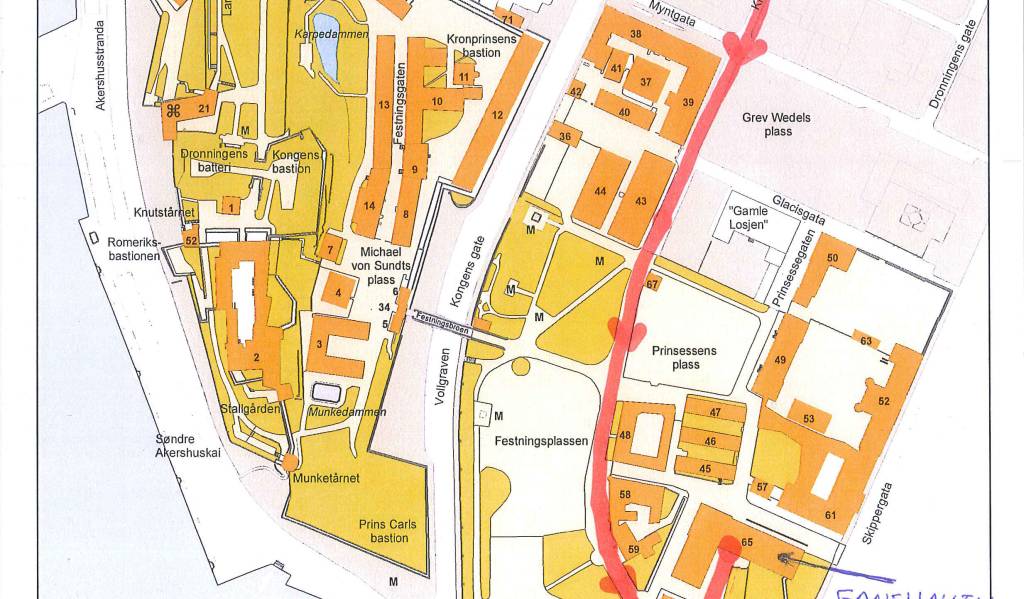
  1. The conference will be hosted at Fanehallen, Akershus Fortress (Akershus festning), located in central Oslo. Akershus Fortress is a historic military site and an important symbol of Norwegian defence history, offering a unique setting for the conference.

    Please note that access to parts of the conference venue at Akershus Fortress may be subject to security procedures.

    Information on registration requirements and access arrangements will be provided well in advance of the conference.

    Video showing how to get to Fanehallen from the main gate of the Akershus Fortress

  2.  

    • By air: Oslo Airport Gardermoen (OSL) is the main international airport, with frequent connections to major European cities. The airport is approximately 20-50 minutes from central Oslo by train.
    • By train: Airport express trains (Flytoget) and regular trains connect OSL to Oslo Central Station (Oslo S) several times per hour.
    • Local transport: Akershus Fortress is within walking distance of Oslo Central Station and is well connected by public transport.

    For more information about travel to and in Oslo, see Visit Oslo.

  3. A number of hotels are located within walking distance or a short public transport ride from Akershus Fortress. Participants are responsible for booking their own accommodation.

    We offer negotiated prices at:

    • First Hotell Millenium
    • Scandic St. Olavs plass

    Information about hotel bookings will be shared once you have completed your registration.

  4. Buses, trams, and subway
    Ruter, public transport in Oslo: https://ruter.no/en
    The Ruter app can be downloaded in App Store and GooglePlay.

    Taxi
    Oslo is a small city with hotels in walking distance from the Akershus Fortress and well developed public transport.

    If you want to book a taxi, be aware that it is only allowed to the main gate of Akershus Fortress. You will have to walk there from Fanehallen (approx. 3 min).

    Examples of taxi companies, telephone number, and the name of their apps:
    OsloTaxi: 02323; Taxifix
    Norges Taxi: 08000; Norges Taxi
    Taxi apps can be downloaded in App Store and GooglePlay.

    Safety in Oslo
    Oslo is a very safe city, also in the evening and at night.
    Oslo safety guide: https://xoslo.com/living/safety 

  5. For questions about the conference or the special issue, please contact Jostein Mattingsdal,  jomattingsdal@mil.no, Norwegian Defence University College

How to get to Fanehallen

Click and download map (pdf)

Right arrow
Bilde_kart Fanehallen Artilleriloftet

Presenting work under review at the conference

Authors whose manuscripts are still undergoing peer review at the time of the conference are welcome to present their work.

This is a normal part of the publication process and will not affect participation. On the contrary, the conference provides an opportunity to receive valuable feedback, strengthen manuscripts, and engage in academic and professional dialogue with peers, practitioners, and decision-makers.

Call for papers Special Issue of Necesse

TDUKE26_Call_for_Papers

The deadline for submissions has passed and the call is closed.

In connection with the conference, the Norwegian Defence University College and the National Defence University of Ukraine invite submissions for a special issue of the open access peer-reviewed journal Necesse.

Review notifications: December 2026–February 2027
Expected publication: Spring 2027

About Operation Ellisiv

The Nansen Programme is Norway’s long-term framework for supporting Ukraine in response to Russia’s full-scale invasion. Initially launched in 2023 with a five-year allocation, the programme has since been extended until 2030 and represents the largest and longest-lasting aid commitment in Norway’s history.

Within this framework, the Norwegian Armed Forces have consolidated their support to Ukraine under Operation Ellisiv. Read more about how the Norwegian Armed Forces assist Ukraine

The Norwegian Defence University College contributes to Operation Ellisiv through education, leadership development, and research on military operations, in close cooperation with Ukrainian partners. This work includes programmes such as Black Sea Battle Lab, Vantage Train, and Ukraine and Full-Spectrum Threats.

Total Defence – Ellisiv Forum 26 builds on this work by creating a dedicated arena for analysing, discussing, and sharing experiences from Ukraine to strengthen defence capability and prepare for future security challenges.

Continue the conversation in Oslo

Participants may also to note that the annual UKRAINETT+ Conference 2026 will take place at OsloMet, immediately after Total Defence – Ellisiv Forum 26.

Titled “State and Society Under Pressure: Internal and External Dynamics,” the UKRAINETT+ conference addresses themes closely connected to total defence, societal resilience, and foreign support for Ukraine.

Together, the two conferences offer participants an opportunity to engage with Ukraine-related security, resilience, and total-defence themes across a full conference week in Oslo, bringing together researchers, policymakers, practitioners, and stakeholders from across relevant academic and professional communities. Find more information about the conference here.

Keep up to date about the NDUC events and research activities (in Norwegian and English)